The $2.4M cost of not having a technology portfolio function
Nobody builds a business case for the portfolio function. They just absorb the cost of not having one. I ran the math for a mid-size organization, and it came to about $2.44M a year.
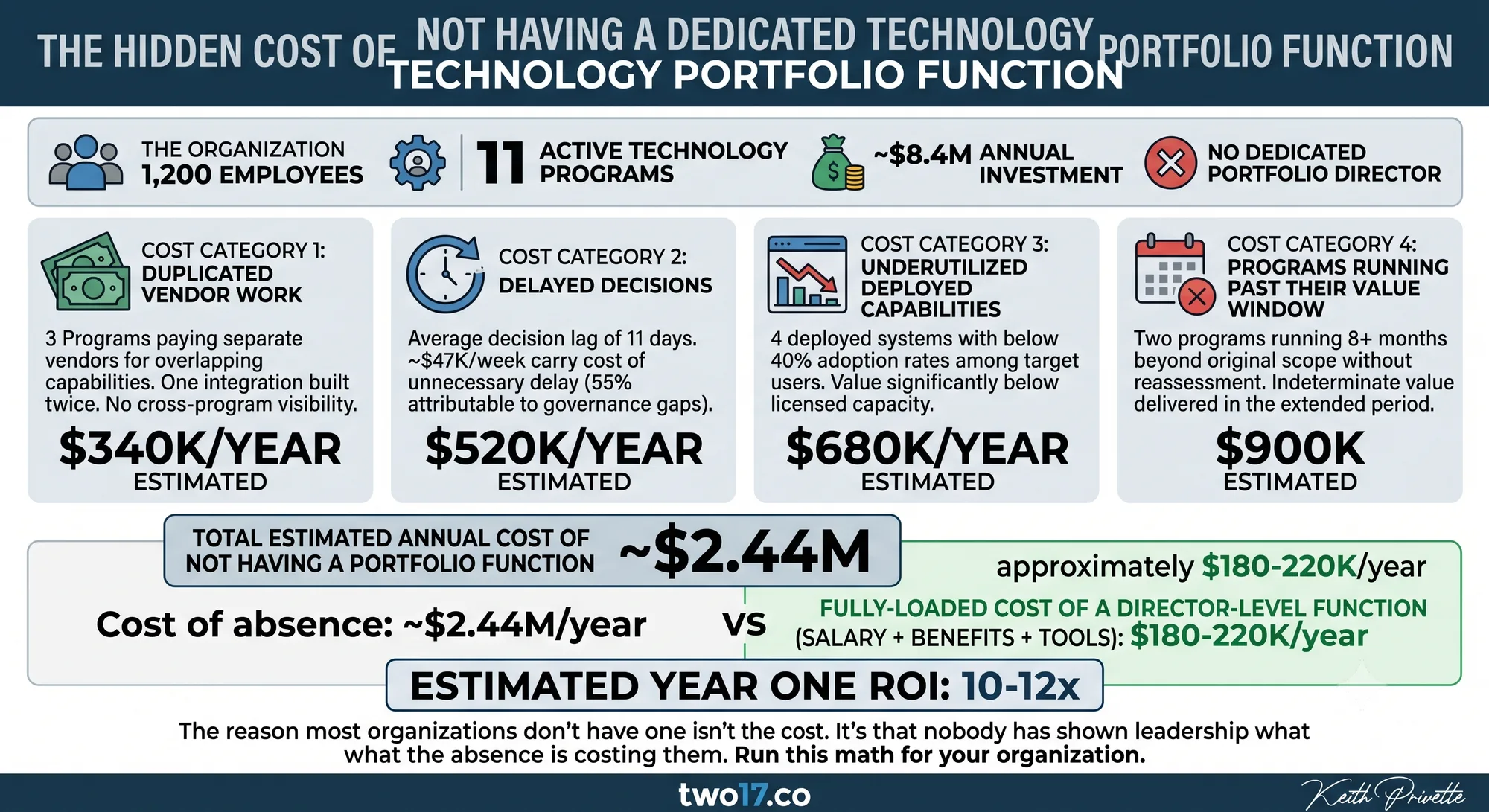
Nobody builds a business case for the portfolio function. They just absorb the cost of not having one, in ways that never get traced back to its absence.
So I ran the math for a mid-size organization: 1,200 employees, 11 active programs, about $8.4M in annual technology investment, and no portfolio director.
Where the money goes
- Estimated annual cost ($K)
Duplicated vendor work: about $340K a year. Without visibility across programs, three were paying separate vendors for overlapping capabilities. One integration was being built twice by teams who didn’t know about each other.
Delayed decisions: about $520K a year. The average decision lag was 11 days. At a blended run rate of roughly $47K a week across active programs, with about 55% of delays attributable to governance gaps, that’s around $520K in pure carrying cost.
Underused capabilities: about $680K a year. A capability audit found four deployed systems with adoption below 40%. Annual license and support for those four: $680K. Value realized: far below what was being paid for.
Programs running past their value window: about $900K. Two programs ran eight-plus months beyond scope without anyone reassessing the business case. Combined spend in that extended period: about $900K. Value delivered: unknown, because nobody was measuring.
- annual cost of having no portfolio function
- ~$2.44M
- fully loaded cost of a director-level portfolio function
- $180–220K
- estimated year-one return
- 10–12×
I’ve never seen an organization run this analysis and decide not to build the function. The reason most don’t have one isn’t cost. It’s that nobody has shown leadership what the absence is costing them. That’s a presentation problem, not a budget problem.
The PMO is becoming a value office, or becoming irrelevant
This matters more now because the role itself is shifting. The organizations getting the most from their technology portfolios are building governance around outcomes, not projects. The traditional PMO that reports status is being replaced by portfolio functions that own business value delivery.
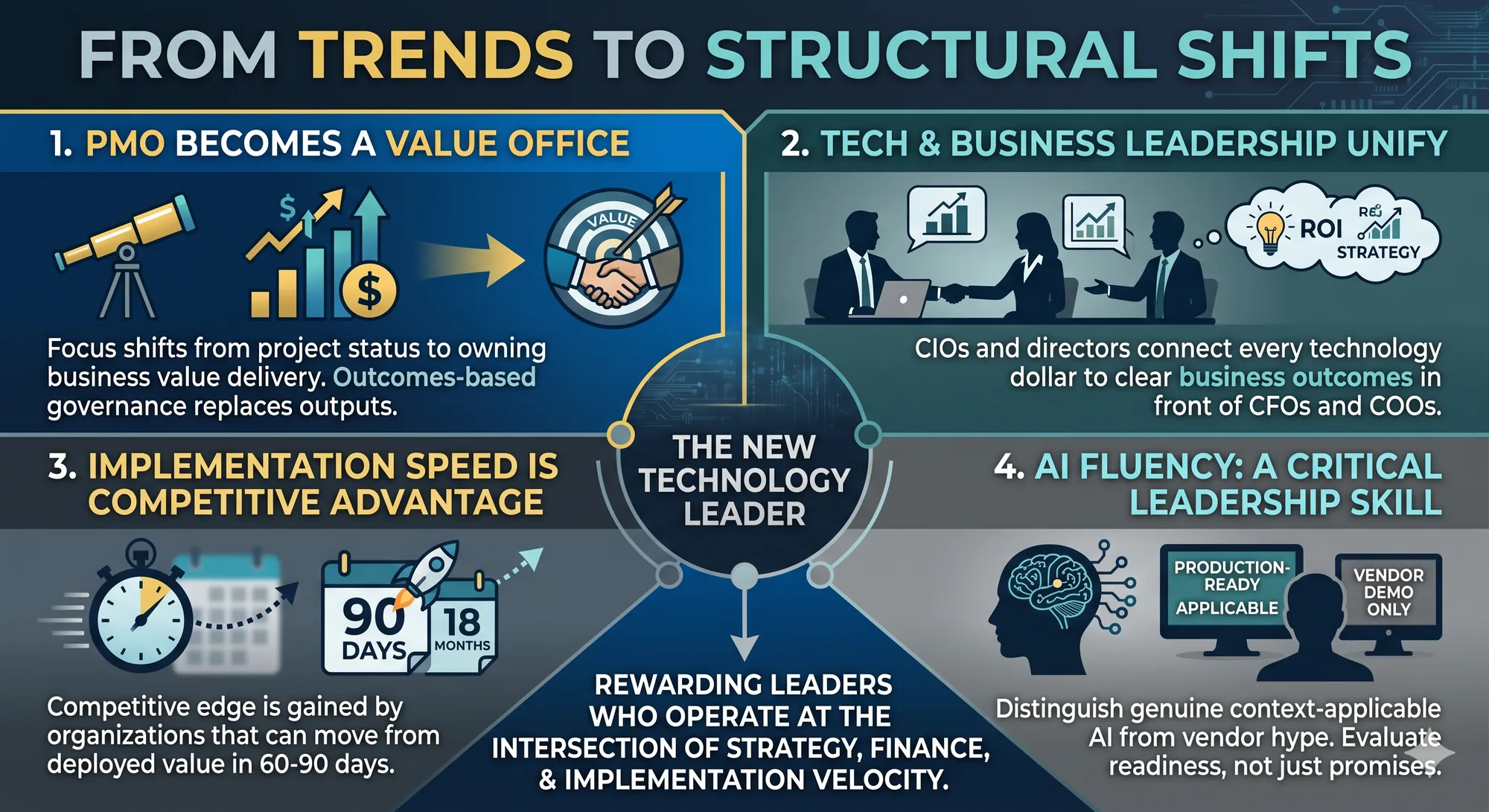
The same shift is happening to the people. The line between technology leader and business leader is disappearing. The CIOs and program directors with the most influence are the ones who speak finance, not just IT, and who can connect every dollar of technology investment to a business outcome in a room full of CFOs and COOs.
Two patterns I see most
The absence of a real portfolio function tends to show up in two recognizable ways.
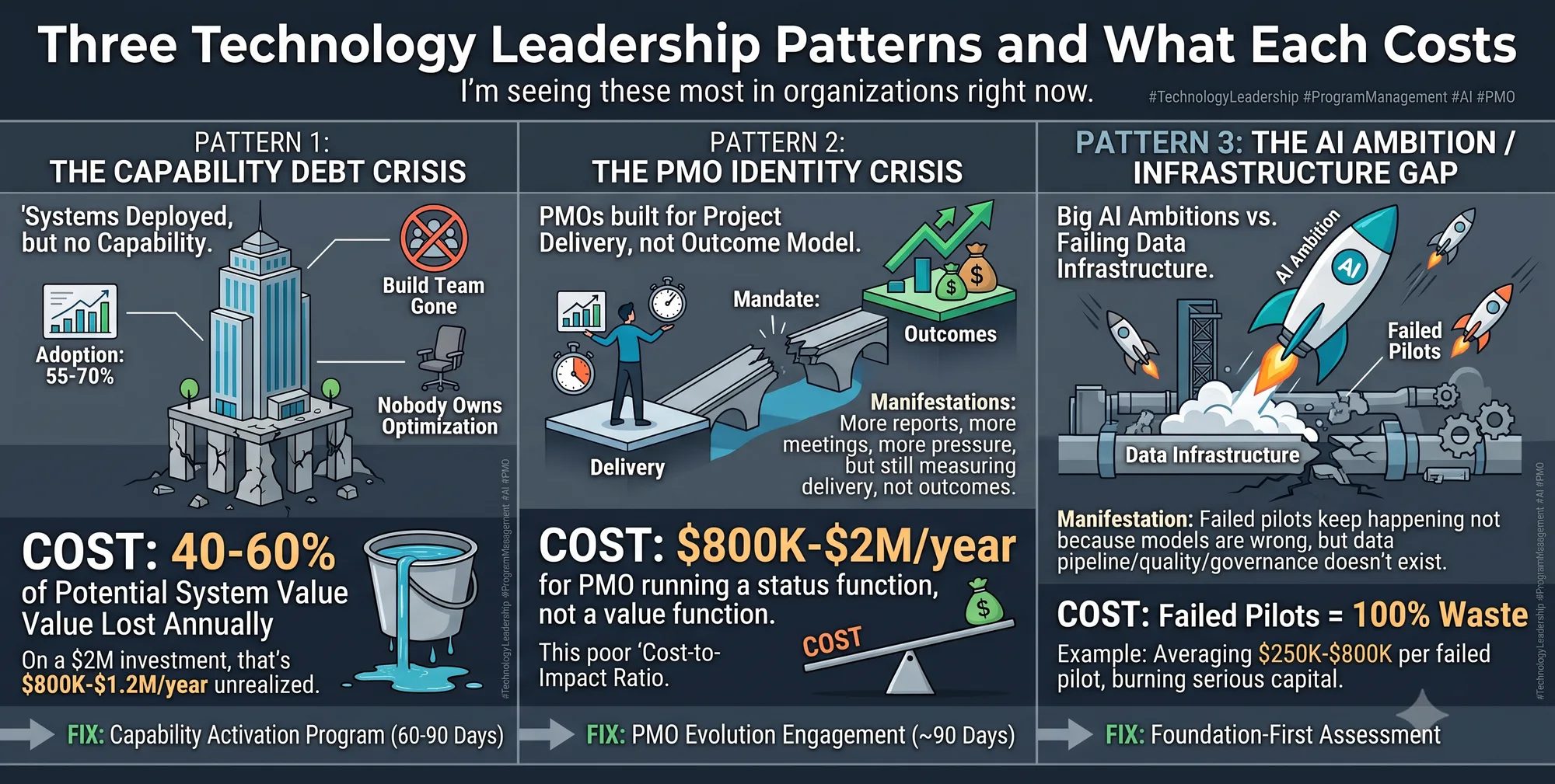
The capability debt crisis. Organizations that spent 2020–2023 deploying technology are discovering they deployed systems but didn’t build the capability to run them. Adoption sits at 55–70%, the build team is gone, nobody owns optimization, and performance slowly degrades. I estimate 40–60% of a system’s potential value is lost every year in this state. On a $2M investment, that’s $800K to $1.2M a year left on the table. The fix isn’t a new implementation. It’s a capability activation effort, usually 60 to 90 days.
The PMO identity crisis. PMOs built for project delivery are being asked to operate in an outcome model without the mandate, tools, or structure to do it. The result is more reports, more meetings, and more pressure to show value, while still measuring delivery instead of outcomes. A PMO can cost $800K to $2M a year in a mid-size enterprise. Run as a status function rather than a value function, that cost-to-impact ratio is poor, and leadership is noticing. Redesigning the operating model, retraining, and standing up outcome measurement takes about 90 days.
Does your organization have a dedicated portfolio function? If not, what’s the gap costing?