Most technology failures aren't technical. They're decision failures.
The programs that struggle most aren't underfunded or under-resourced. They're under-decided. Here's what slow decisions really cost, and how to design governance for speed.
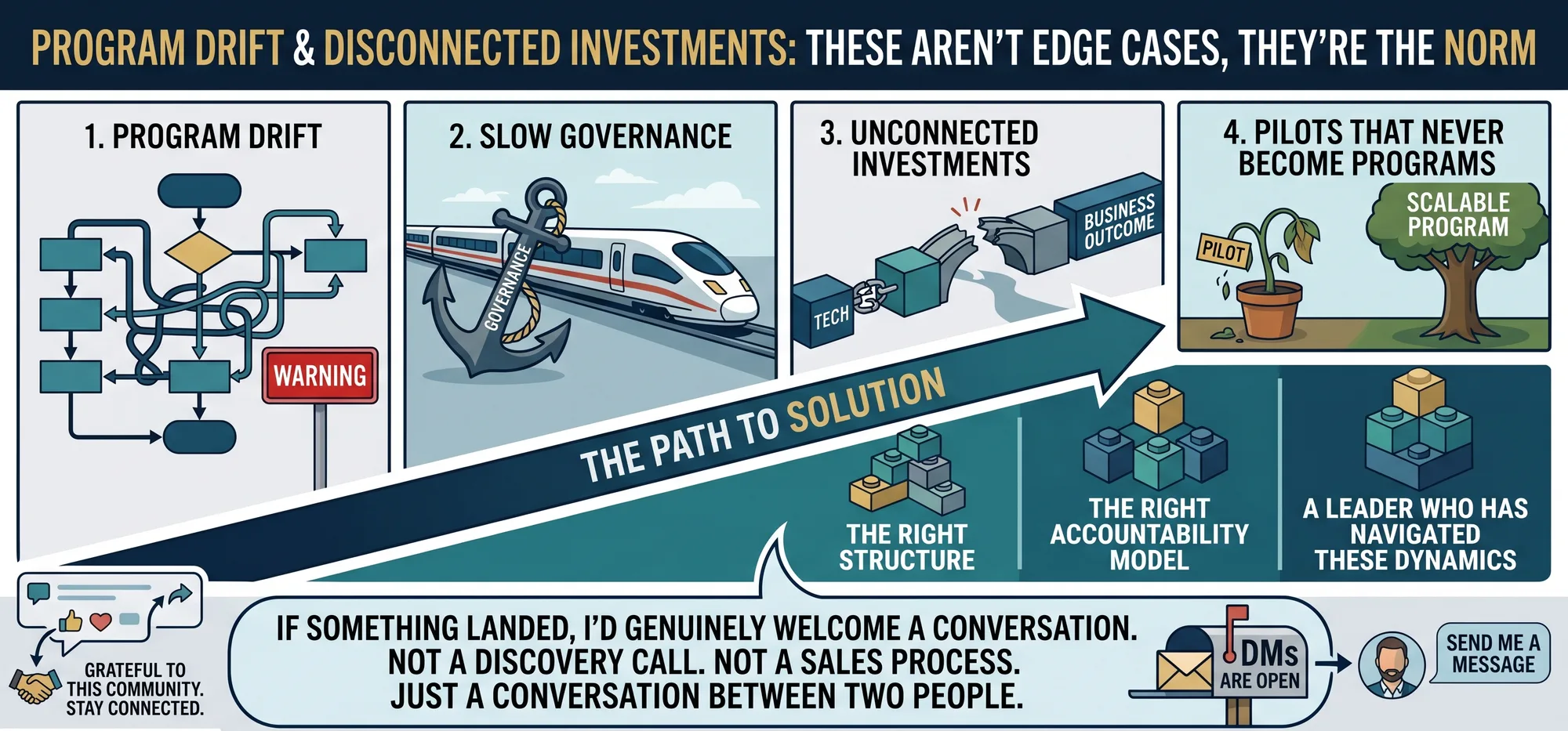
Most technology failures aren’t technical. They’re timeline failures, and underneath every timeline failure is a decision that took too long.
I’ve reviewed dozens of technology programs. The ones that struggle most weren’t underfunded. They weren’t under-resourced. They were under-decided: leadership waiting for the perfect business case, steering committees deferring to next quarter, procurement cycles adding 60 days to a 90-day problem.
The technology was never the issue. The decision was.
The cost nobody puts in the business case
Here’s the math that rarely makes it into a business case: every 30-day delay in a technology implementation decision can cost more than the implementation itself. The cost doesn’t show up as a line item. It shows up as manual workarounds, duplicated effort, and the compounding complexity of the problem you’re not solving while you wait.
Because it never appears on a budget report, nobody owns it. And what nobody owns, nobody fixes.
The fastest path to ROI on any technology investment isn’t a better vendor. It’s a faster decision, followed by a structured implementation that’s designed to deliver value before the ink is dry on the contract. That’s not a radical idea. It’s just rarely how programs are built.
The bottleneck that never makes the post-mortem
Post-mortems document what went wrong in execution. They almost never document what went wrong in governance. And the governance bottleneck I see most often, and the one that costs the most, is the approval queue.
It looks like this. A technical decision needs sign-off. It goes to the steering committee. The steering committee meets every two weeks, and the next meeting is nine days away. So the decision waits.
Meanwhile:
- The implementation team is blocked
- The vendor is still billing
- The timeline is slipping
- Nobody is officially responsible for the nine-day delay
Multiply that across a program and it adds up fast. I’ve seen a post-mortem blame “scope creep” when the real cause was 14 approval delays totaling eight weeks.
This isn’t a people problem. It’s a structural one. Most governance frameworks were designed to manage risk, not velocity. So they do a decent job of preventing bad decisions and a terrible job of enabling fast ones.
Governance designed around the speed of the work
Nothing is wrong with governance designed for control, until it becomes the primary bottleneck in the very thing it’s supposed to protect. The organizations that get this right don’t remove governance. They redesign it.
Traditional governance
- All decisions escalate to the steering committee
- The committee meets every two weeks
- Average decision lag: 8–12 days
- Teams learn to avoid decisions rather than make them
Velocity governance
- Tiered authority: technical decisions stay with the technical lead, program decisions with the program director, strategic decisions go to steering
- An emergency lane: anything blocking delivery for 48+ hours gets a same-week path to resolution
- Standing exceptions: the 15 most common decision types are pre-approved within defined limits
- The steering committee receives summaries, not requests
The result isn’t less oversight. It’s oversight at the right level, with the right urgency, at the right time.
The key idea is tiered decision authority that matches the speed of the work. Not everything needs a steering committee. Not everything needs a change advisory board. What every decision needs is the right decision-maker, at the right level, with the right information, available when the decision is actually needed.
That sounds obvious. It’s surprisingly rare.
How to start this week
You don’t need a governance overhaul to begin. Three moves make an immediate difference:
- Count the waiting. For your most important program, list every decision from the last 90 days and how many days each one waited for approval. The total is usually a shock, and it’s the most persuasive number you’ll bring to your next steering meeting.
- Map decision rights before the next sprint. Who can approve what, at what dollar threshold, without a committee meeting? Write it down. It will save weeks.
- Pre-approve the routine. Look at the decisions your committee approves every time. Those don’t need a meeting. They need a documented boundary.
What decision in your current technology portfolio has been waiting longer than it should?