Drift is the program failure nobody reports, and how to know when to stop
A drifting program is still running, the team is busy, and status is yellow, not red. Here's what 14 weeks of drift actually costs, the stop triggers to agree on before you start, and a post-implementation review that teaches something.
Drift is the slow, expensive version of program failure. It’s harder to see than a failed program, because the program is still running. The team is working. Status is yellow, not red.
But the program has quietly separated from its business case, and the gap grows every week.
What drift actually costs
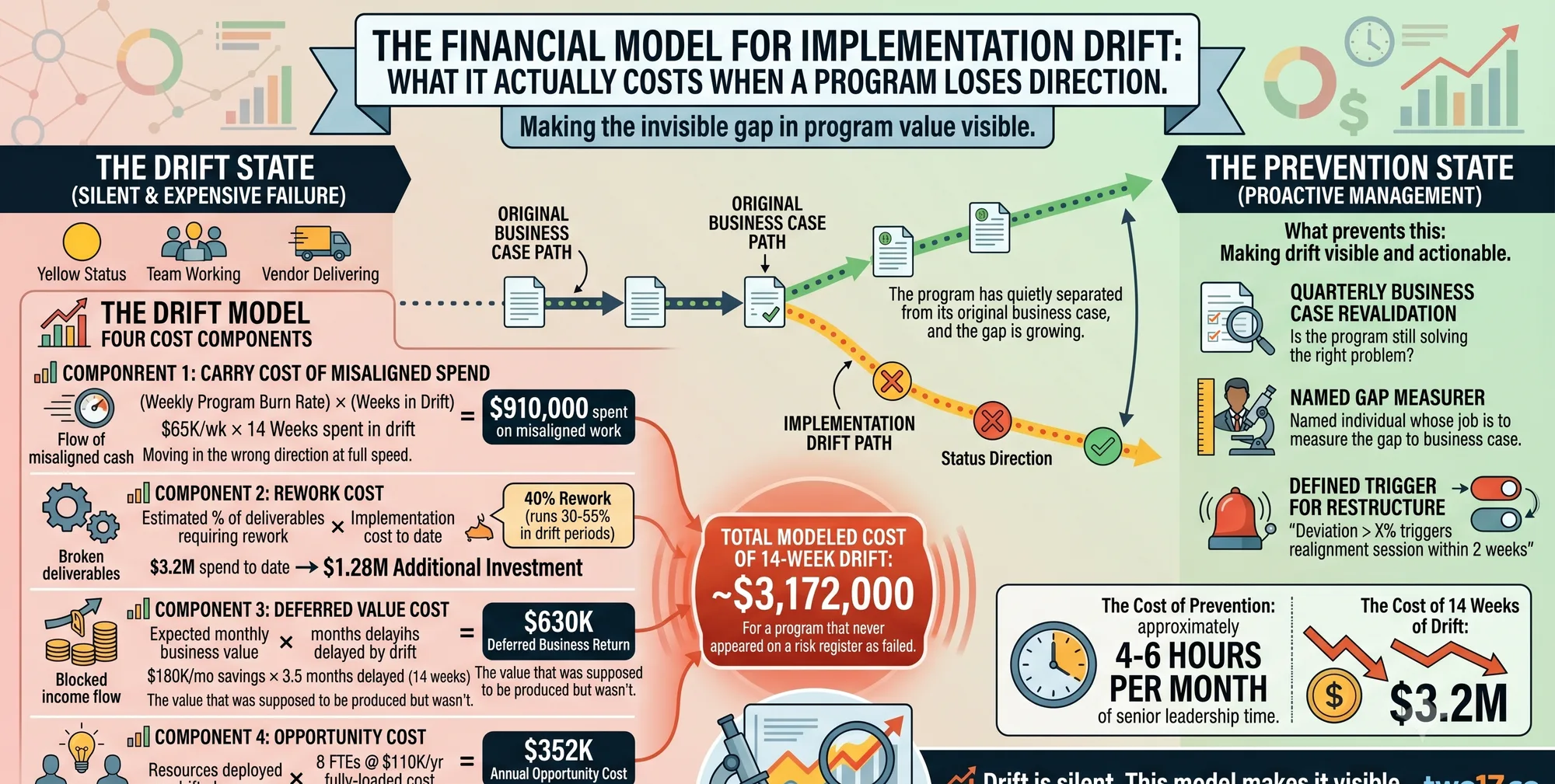
I’ve built this model for three organizations. It’s always worse than leadership expects. Take a program burning $65K a week that spent 14 weeks in drift before it was restructured.
- Carrying cost of misaligned spend: $65K × 14 weeks = $910K spent moving in the wrong direction at full speed.
- Rework: drifted deliverables typically need 30–55% rework. On $3.2M spent to date at 40%, that’s $1.28M to get back on track.
- Deferred value: the program was expected to deliver $180K a month once deployed. A 14-week drift is about 3.5 months deferred, or $630K in lost return.
- Opportunity cost: eight people at $110K fully loaded is $880K a year tied up. If they could have worked on programs returning 40%, that’s about $352K a year.
Total cost of a 14-week drift: about $3.17M, for a program that never appeared on a risk register as “failed.”
What prevents it
- Quarterly business case revalidation. Not a project review. Is this still solving the right problem?
- A named person who measures the gap between the program’s direction and its business case
- A defined restructure trigger, such as: “If direction deviates X% from the original outcome, we hold a realignment session within two weeks”
The cost of prevention is about four to six hours of senior leadership time a month. Drift is silent. This model makes it visible.
When to stop a program
The most expensive programs in most organizations’ histories weren’t the ones that failed fast. They were the ones that kept going long past the point where the evidence said stop.
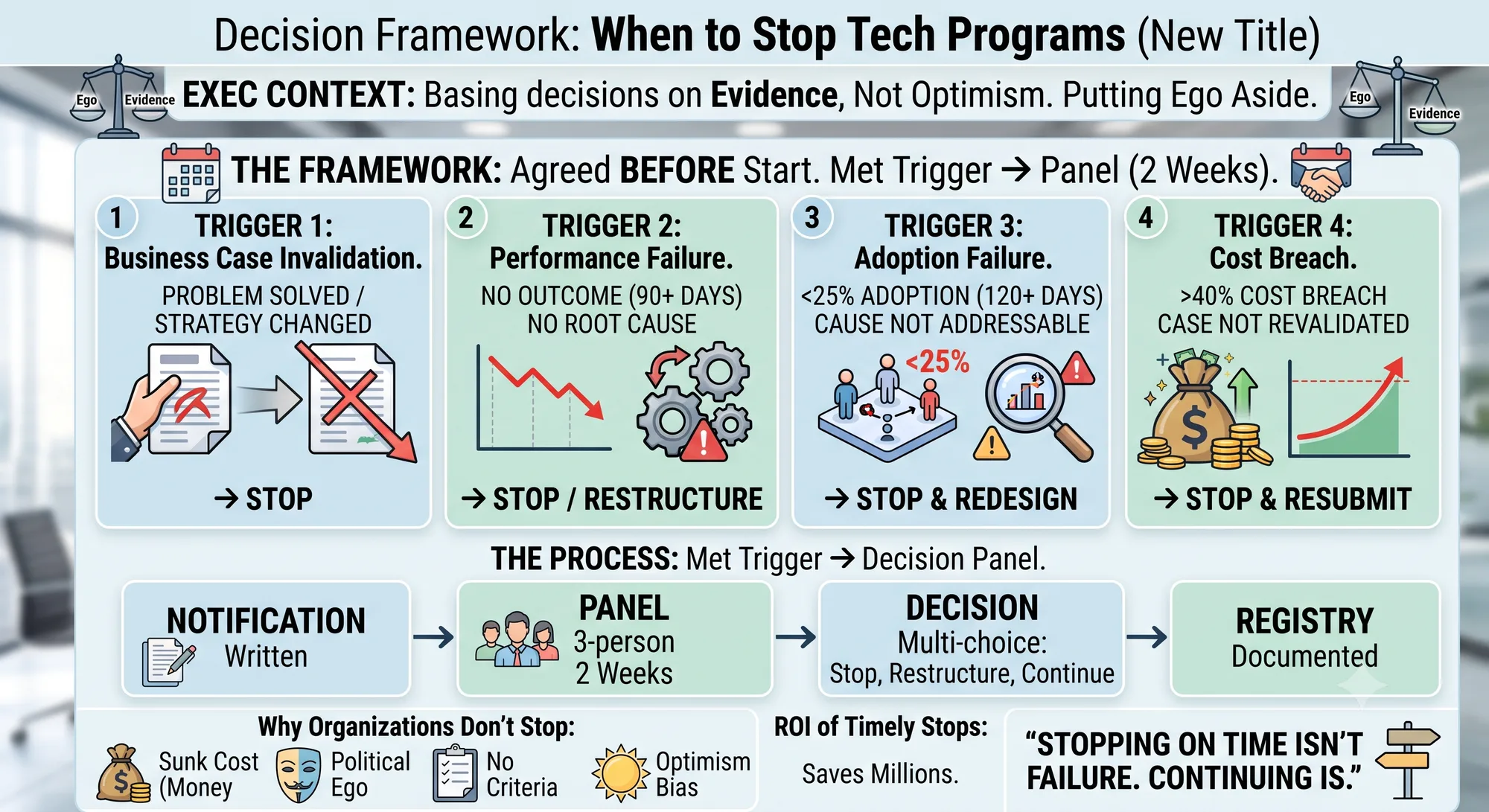
Organizations don’t stop for four predictable reasons:
- Sunk cost. “We’ve invested $X, we can’t stop now.” The $X is gone either way. The question is whether the next dollar is well spent.
- No stopping criteria. If nobody wrote down what “not working” looks like, nobody is authorized to call it. It continues by default.
- Political exposure. The executive who approved it doesn’t want to be the one who stops it.
- Optimism bias. “We’re almost there.” Always, until suddenly we’re not.
One of the most useful lessons of my career: define the kill criteria before the success criteria. Every program has a definition of success. Almost none have a documented definition of “this isn’t working and we need to restructure.” So programs that should pivot at month four run until month 18, and the post-mortem is brutal and expensive. Kill criteria aren’t pessimism. They’re the fastest path to course correction.
Stop triggers, agreed before the program starts
- Trigger 1Business case invalidated
The core problem has been solved another way, has changed significantly, or is no longer strategic. → Stop.
- Trigger 2Structural performance failure
90+ days with no measurable business outcome and no correctable root cause. → Stop or restructure within 30 days.
- Trigger 3Adoption failure
Capabilities available 120+ days, active adoption below 25%, and the cause can’t be fixed with the current approach. → Stop, redesign adoption, restart selectively.
- Trigger 4Cost breach
Full capability cost has grown more than 40% above the approved case and the case can’t be revalidated at the new cost. → Stop and resubmit.
The process: when any trigger is met, the program director notifies the sponsor in writing. A three-person panel (sponsor, a CFO representative, and an independent reviewer) convenes within two weeks and chooses one of three options: stop, restructure with a new case, or continue with a documented exception and a 60-day re-evaluation. The decision goes in the portfolio registry.
The best program I’ve helped stop saved about $3.8M in the 14 months that would otherwise have been spent. The team wasn’t happy. The CFO was.
Then make sure the next program learns
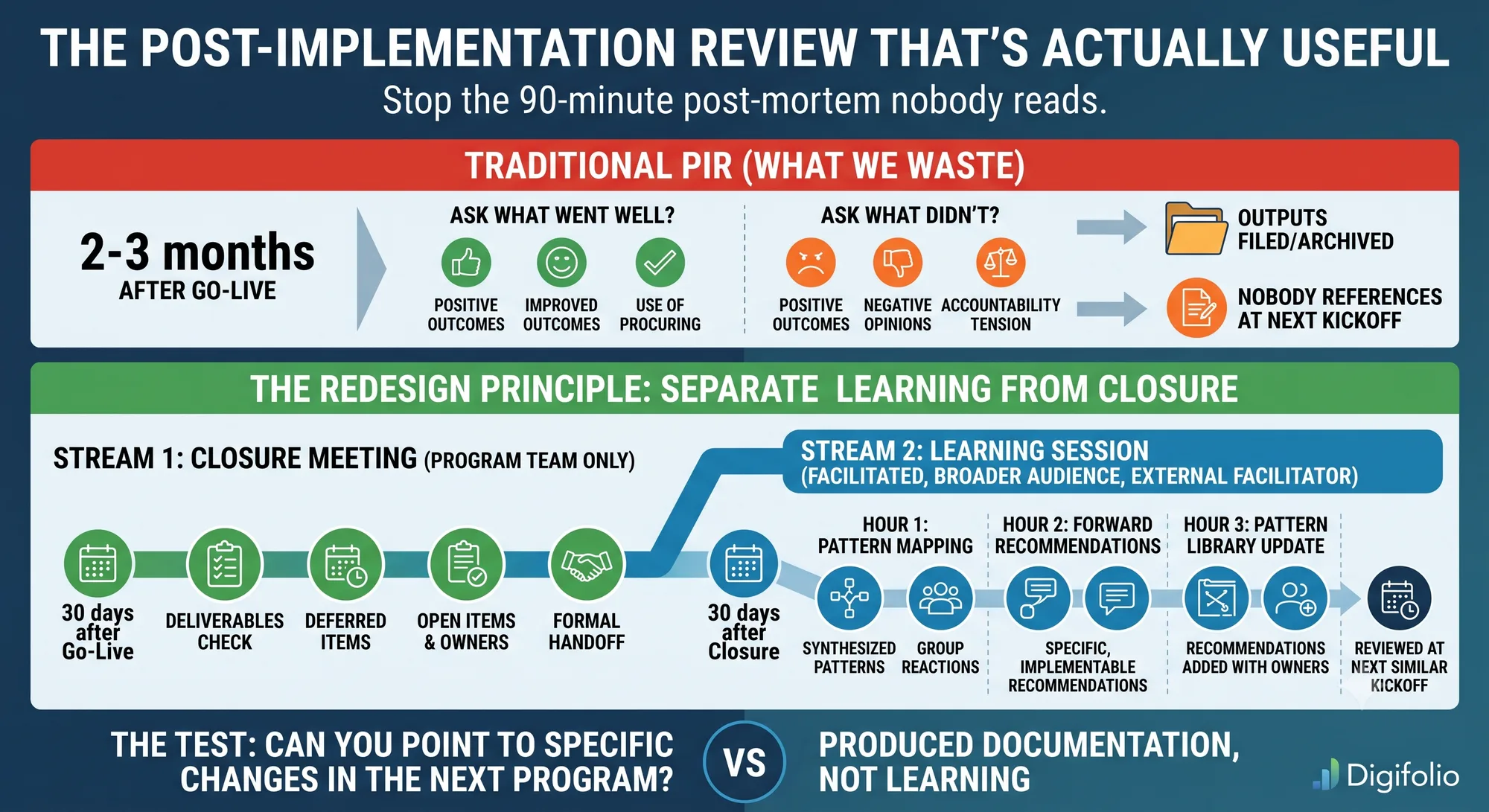
Post-implementation reviews are one of the most consistently wasted opportunities in technology. They happen two or three months after go-live, ask what went well and what didn’t, and the output gets filed. Nobody references it at the next kickoff.
The fix is to separate learning from closure. A traditional review tries to do both at once, and they’re in tension: people who feel accountable for what went wrong edit their contributions to minimize exposure.
- Closure meeting (program team only): what was delivered, what was deferred, open items and owners, and the formal handoff.
- Learning session (30 days later, facilitated by someone outside the program, broader audience): built on anonymous pre-work questions sent a week ahead:
- What was the single most impactful structural decision, positive or negative?
- As sponsor of the next similar program, what would you require before kickoff that wasn’t in place here?
- Which business case assumption turned out wrong, and how did it affect the outcome?
- What would you tell the next program manager that nobody told this one?
The session itself runs in three parts: pattern mapping from the synthesized responses, one specific and implementable recommendation per pattern (not “improve stakeholder communication,” but “require a named business outcome owner to attend program meetings twice a month for the first 90 days”), and an update to the organization’s pattern library, each item with an owner, to be reviewed at the next similar kickoff.