The 90-day value window every technology program ignores
There's a window at the start of every program where its trajectory gets set. Here's how to use those 90 days, and what a healthy program should be able to show at day 30, 60, and 90.
There’s a window in every technology program where the trajectory gets set, and most organizations don’t even know it’s open.
I call it the 90-day value window. What happens in those first three months determines whether a program reaches measurable ROI quickly or spends the next year explaining why it hasn’t yet.
How the window works
The 90-day value window
- Days 1–15Define the business outcome, not the scope
What measurable change in the business are we funding? Not features. Not integrations. Outcomes.
- Days 16–30Map the capability, not the technology
What does the organization need to be able to do that it can't do today? Technology comes after this answer, never before.
- Days 31–60Build the minimum viable program structure
Governance that enables decisions, not just controls them. Roles that own outcomes, not just tasks.
- Days 61–75Deploy the first value-producing slice
Something real and measurable that proves the investment direction before full commitment.
- Days 76–90Recalibrate
Not a post-mortem. A forward adjustment based on real data, not assumptions.
Organizations that follow this sequence, even loosely, consistently reach measurable ROI faster than those that don’t. The window doesn’t wait for you to find it.
Get the order right before the first sprint
Most programs begin with scope, timeline, and budget. Those are the right inputs, but the order matters. Here’s the sequence that consistently produces faster time to value:
1. Write the business outcome statement first. One sentence. Plain language. Measurable. “This program will enable [business unit] to [do X differently], resulting in [Y outcome] by [date].” If you can’t write this, don’t start sprint planning.
2. Map the capability gap, not the feature gap. What does the organization need to be able to do that it can’t do today? Features come later. Capability comes first.
3. Identify the adoption risk before the technical risk. Who will use this? Who will resist it? What behavior change is required? These answers belong in the program plan, not in the training deck at month nine.
4. Design governance for decision speed, not just oversight. Who can approve what, at what dollar threshold, without a committee meeting? Map it before the first sprint. It will save weeks.
5. Define the 60-day checkpoint in writing. What will you know, measurably, at day 60 that tells you the program is on the right trajectory? Not on schedule. On trajectory.
Programs built this way don’t move faster because they rush. They move faster because they’re aligned before they start moving. Pre-work isn’t overhead. It’s the accelerator.
Speed to first value vs. complete implementation
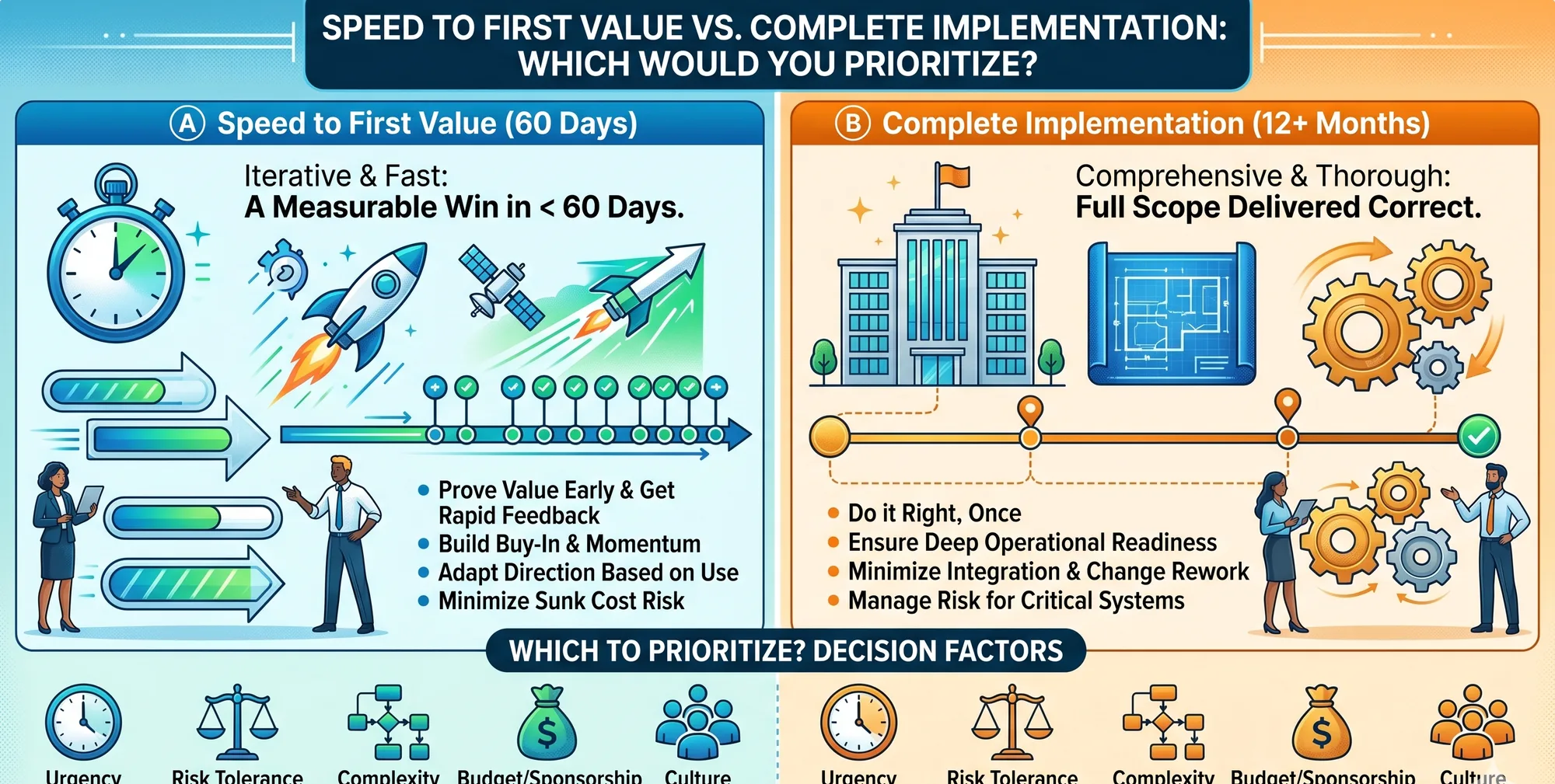
This is where many leadership teams disagree. Do you push for a measurable win in under 60 days, or do the comprehensive, do-it-once implementation?
The honest answer depends on your urgency, risk tolerance, complexity, sponsorship, and culture. But the 90-day window is built on a bias toward proving value early: deploy a real slice, learn from it, and use the evidence to steer the rest. A complete implementation that delivers nothing measurable for a year has to survive a lot of budget conversations on faith.
What a healthy program can point to at 30, 60, and 90 days
Not “on schedule.” Producing value. Here’s what each milestone should actually demonstrate.
At 30 days
- A business outcome statement validated by a business stakeholder, not IT
- Capability gaps documented and prioritized
- An accountability structure in place: named humans, named outcomes
- A first governance checkpoint that produced at least one real decision
- Adoption risk assessed, with a plan to address it
At 60 days
- A first value-producing capability deployed, even if small
- At least one business metric moving in the right direction
- At least one wrong assumption surfaced and corrected
- Finance able to see where value is being generated, not just where money is being spent
At 90 days
- The business case confirmed or restructured based on real data
- A repeatable process for deploying value in cycles
- Business stakeholders who can explain what the program is delivering, in their language rather than IT’s
Where is your current program in this window?